Utility-Scale BMS
Utility-Scale BMS
Designed for utility-scale energy storage systems requiring safe, scalable control of high-voltage battery stacks up to 1500V.
Engineered, designed, and manufactured in the USA and Canada to support reliable, compliant deployment.
KEY CAPABILITIES
KEY CAPABILITIES
- Supports battery stacks up to 1500V DC
- Modular cell interface architecture including 52s and higher configurations
- Designed for multi-megawatt energy storage deployments
- Provides cell-level monitoring, balancing, and system level control
- Designed to support integration into UL 1973, UL 9540 and CE compliant energy storage systems
G5 vs. G4 PLATFORM COMPARISON
G5 vs. G4 PLATFORM COMPARISON
FEATURES AND APPLICATIONS
FEATURES AND APPLICATIONS
Modular Architecture
- Distributes measurement and control across system
- Reduces wiring complexity and improves fault isolation
- Enables scalable system design from modules to multi-stack deployments
High-Voltage Capability (up to 1500V)
- Supports integration with utility-scale power conversion systems
- Enables operation of high-voltage battery stacks in grid-connected applications
Advanced Battery Management Features
- Patented continuous cell balancing algorithms used during operation to maximize ESS uptime
- Open-wire detection for improved system diagnostics and fault detection
- Patented advanced State of Charge (SoC) and State of Health (SoH) algorithms for improved operational visibility
COMPLIANCE & SAFETY
COMPLIANCE & SAFETY
Designed for certified energy storage systems.
- UL 1973 Recognized for functional safety
- Designed to support UL 9540 system certification
- Tested across electrical, thermal, and fault conditions
- Supports safe operation in high-voltage energy storage environments
- CE compliant and compliant with UL/CSA/IEC 60730-1 Annex H functional safety requirements
DESIGN & MANUFACTURING
DESIGN & MANUFACTURING
Designed and manufactured in the USA and Canada.
- Engineered, tested, and manufactured in the USA and Canada
- Supports supply chain transparency and domestic sourcing requirements
- Reduces risk associated with overseas manufacturing and logistics delays
- Aligns with North American regulatory and procurement requirements
WHY G5 VS ALTERNATIVES
WHY G5 VS ALTERNATIVES
Why choose G5 over typical BMS platforms?
Technical Details
System Architecture
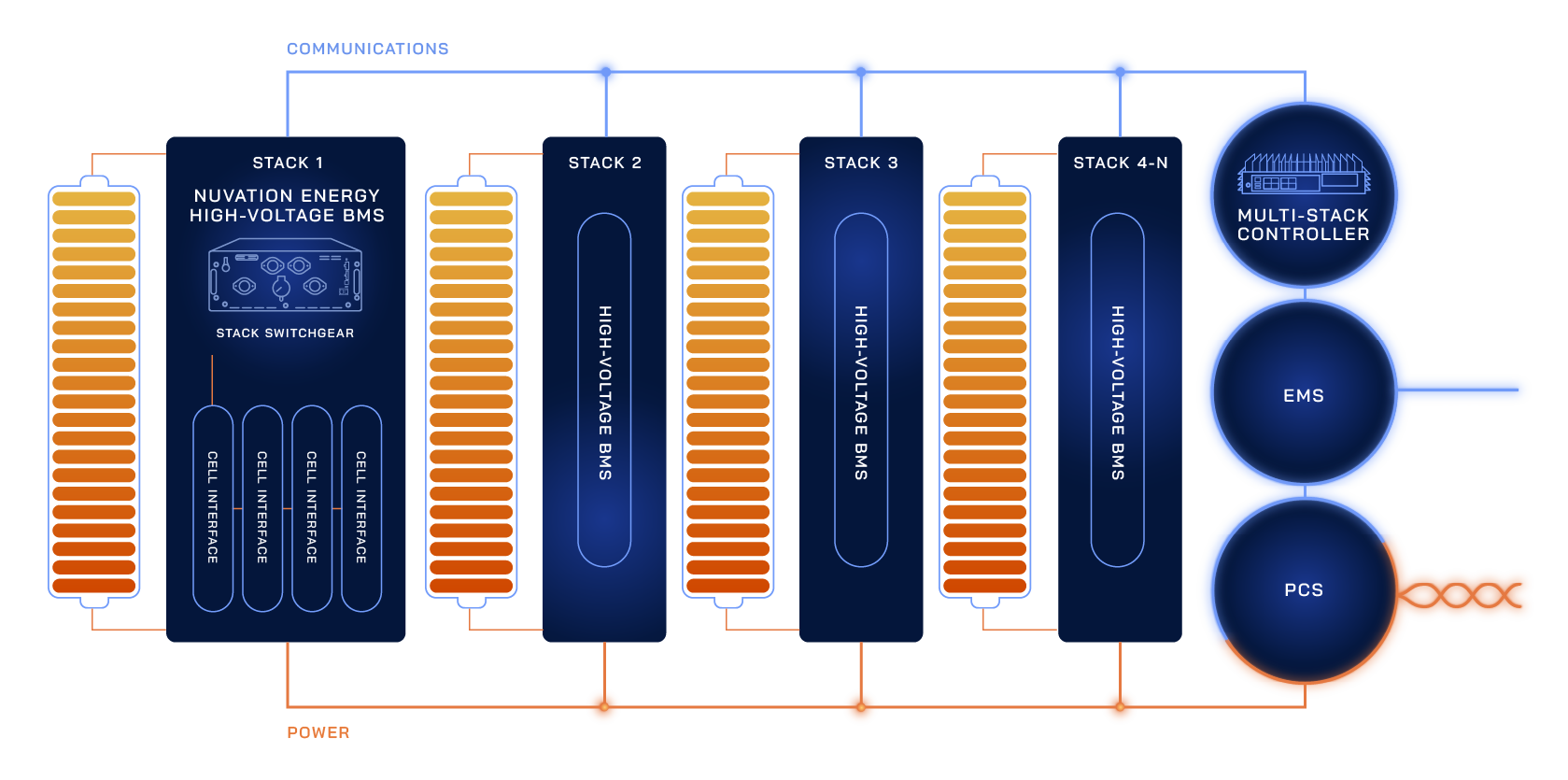
The G5 BMS is built on a modular architecture consisting of:
- Cell Interface Modules for cell-level voltage measurement, temperature monitoring, and balancing
- Stack-level control hardware
- System-level control with multi-stack coordination supported through the Multi-Stack Controller
Cell Interface Architecture
The G5 BMS uses distributed Cell Interface (CI) modules for cell-level voltage and temperature monitoring, balancing, and diagnostics.
Cell Interface configurations include:
- CI-24 (24 channel can monitor up to 24 series-connected cells)
- CI-52 Coming Soon
Technical Specifications
Electrical
- Max system voltage: up to 1500V DC
- Modular architecture supporting higher cell-count configurations, including 52s and 104s
- Current configurations: 200A, 300A, 350A
Architecture
- Distributed modular system
- Cell interface modules + stack-level control
- Multi-stack system support via Multi-Stack Controller
Battery Chemistry
- Designed for lithium-ion cells (1.6V-4.3V)
- Supports additional battery chemistries within supported voltage ranges
System Functionality and Features
- Direct cell-level voltage and temperature monitoring
- Continuous cell balancing during operation
- Open-wire detection for system diagnostics and fault detection
- Integrated pre-charge circuit for safe DC bus connection
- Ethernet-based communication for integration with PCS and external control systems
- Browser-based operator interface for monitoring and configuration
- Configurable operating parameters to align with application and PCS requirements
Compliance
- UL 1973 Recognized
- CE compliant
- Designed to support UL 9540 system certification